







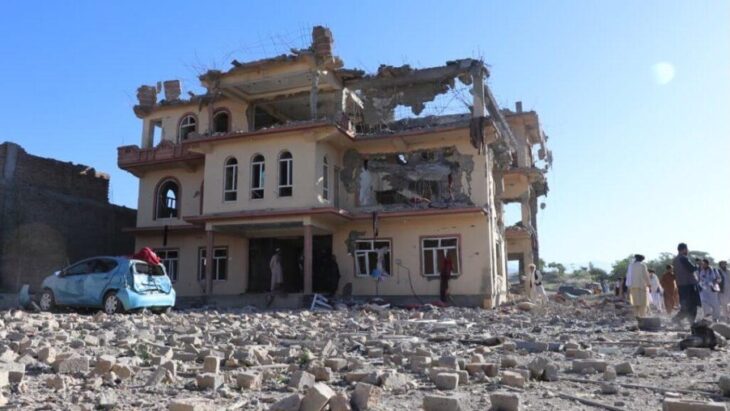

At least 36 people, including women and children, have been martyred and 163 others injured in airstrikes by the Pakistani military regime in southeastern Paktika, Paktia and eastern Kunar provinces, an official said on Monday.
Mullah Hamdullah Fitrah, deputy spokesman for Taliban, wrote on his X account that Pakistani forces carried out airstrikes on Sunday night in Samkani district of Paktia, Giyan district of Paktika and Marawara district of Kunar.
He added: “In Mandokhail village of Samkani district, Pakistani jet aircraft bombed a civilian house, martyring an elderly man and a child, while others were injured. When villagers gathered for rescue, a second strike was carried out, martyring 28 civilians and injuring 158 others.”
According to him, in Walwast village of Giyan district, a house was bombed, martyring six people, including women and children.
Fitrah said that in Barolo village of Marawara district, a civilian house was bombed, causing no casualties but completely destroying the house and causing financial losses.
The deputy spokesman said that in total, 36 civilians, including women and children, were martyred and 163 others injured in last night’s strikes, with three houses completely destroyed.
Former Afghan president Hamid Karzai has described last night’s attacks by Pakistan’s military regime on residential areas in Paktia, Paktika and Kunar provinces as a violation of Afghanistan’s national sovereignty and contrary to international principles.
In a message posted on his X account, Karzai condemned the attacks in the strongest terms. He said Pakistan’s own interest lies in abandoning its policy of confrontation and its double standards toward extremism, and in engaging with Afghanistan based on the principles of good neighbourliness and civilized relations.
Abdullah Abdullah, former chairman of the High Council for National Reconciliation, also strongly condemned Pakistan’s recent attacks on Afghanistan, particularly in Paktia, Paktika and Kunar provinces, which resulted in the martyrdom and injury of many citizens.
In a message posted on his X account, Abdullah wrote: “Such hostile actions not only fail to solve any problem, but also lead to the escalation of tensions. Experience has shown that resorting to force and military actions has never been, and will never be, a sustainable solution for resolving disputes.”
He stated that the only way out of the current situation is commitment to the principles of good neighbourliness, constructive dialogue, and the peaceful resolution of disputes.
Jan Egeland, secretary general of the Norwegian Refugee Council, reacting to Pakistan’s attacks on Afghanistan, said civilians and civilian infrastructure must never be targeted.
In a message posted on his X account, he called on the military forces of Afghanistan and Pakistan to abide by international humanitarian law and resolve their differences through dialogue.
Stana Gul Sherzad, leader of the Afghan Millat Party, says he strongly condemns Pakistan’s recent airstrikes in Afghanistan’s Kunar, Paktia and Paktika provinces, describing such actions as against the interests of the people of both countries, dangerous for regional stability, and a clear violation of international principles.
Sherzad said the killing and injury of innocent civilians, women and children in these attacks is a great tragedy. He extended his heartfelt condolences to the families of the martyrs, prayed for the martyrs to be granted Jannat-ul-Firdaws, and wished the wounded a speedy and full recovery.
Sherzad said: “For the defence of our motherland, the protection of national sovereignty and the preservation of territorial integrity, emotions and slogans alone are not enough. What is needed are modern education, professional cadres, advanced technology and contemporary defence equipment. A nation becomes strong when the paths of knowledge and learning are open to it. We Muslims believe in the support of Allah Almighty, but Islam also guides us toward knowledge, effort and wise planning. If victory could be achieved only through prayer and waiting, then many conflicts in the world would have been resolved in this way. Therefore, restricting modern education creates a major obstacle to a nation’s progress and defence capability.”
Mawlavi Muhajir Farahi, deputy minister for publications at the Ministry of Information and Culture, described Pakistan’s attacks last night as a cowardly act and said revenge for the attacks would be taken at an appropriate time. Speaking at a seminar in Parwan province on enhancing the intellectual, ideological and professional capacity of journalists, he said: “Pakistan’s military regime carried out bombardments last night in Paktia, Paktika and Kunar provinces in a cowardly manner; revenge for this will certainly be taken at an appropriate time.”
He added that the system’s decisions are not made based on emotions; rather, measured actions are taken at the appropriate time.
Views: 1