







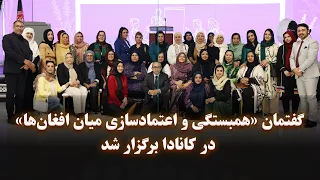
The Afghan Women Coordination Umbrella organized a meeting titled “Solidarity and Trust-Building Among Afghans” in Canada.
The event brought together civil society and human rights activists from around the world, participating both in person and online.
The purpose of this discussion-focused program was to explore practical ways to strengthen trust, understanding, and cooperation among Afghans—both inside the country and across the diaspora.
Jamila Afghani, a member of the Afghan Women Coordination Umbrella, stated that 80 civil society and human rights activists from various parts of the world and Afghanistan participated in the event online, while 60 others attended in person.
Amina Ahmady, another member of the Afghan Women Coordination Umbrella, described the lack of trust among Afghans as a serious issue and emphasized the need for dialogue between Afghans inside and outside the country to reach mutual understanding and find solutions to this challenge.
A key part of the program was a panel discussion titled “Examining Divides and the Lack of Solidarity Among the People of Afghanistan, Especially Women, Individuals, Groups, and Institutions,” moderated by Jamila Afghani.
Panelists included Shinki Karokhail, Najia Ziwari, Irfanullah Irfan, Homa Alizi, Wazhma Frogh, Adela Mohseni, and Tsanga Siddiqi, who participated both in person and online.
Irfanullah Irfan, former representative of Kabul in the Wolesi Jirga, emphasized the role of religious scholars in strengthening unity and solidarity among Afghans. He also criticized some clerics, saying that they consider themselves special representatives of God and have turned religion into a family inheritance.
Najia Zewari, a women’s rights advocate in Afghanistan, stressed that in order to build trust and solidarity among Afghans, all Afghans—regardless of where they live—must unite under a common cause to save Afghanistan.
Shinkai Karokhail, former member of the Wolesi Jirga and former Afghan ambassador to Canada, urged Afghans to refrain from pursuing personal and ethnic agendas that deepen mistrust, and emphasized the need for honest and inclusive national dialogue among Afghans.
At the conclusion, participants were divided into five working groups to present suggestions on enhancing solidarity and trust among Afghans.
Participants regarded the meeting as an important step toward building trust and unity among Afghans and called for continued dialogues and similar initiatives in the future.
In the concluding part of the program, Fazl Ghani Kakar, a religious scholar, emphasized in his closing remarks: “We must repent for past shortcomings, act with the intention of seeking God’s (J) approval, and work with a spirit of Afghan-cantered unity and solidarity for a better future.”
Views: 19