






Wesal TV(Oshawa): For Oshawa mother Emily Clairoux, concerns about social media began long before Ottawa proposed restricting access for children under 16.
Clairoux, who has two children, says harmful online content is her biggest concern.
“Kids YouTube has weak filters that allow inappropriate videos through,” she said. Clairoux also pointed to online influencers and adults using gaming platforms to communicate with children.
“Everything else can be mitigated through active parent supervision. I can’t control what other people are sharing that my child becomes exposed to.”
Clairoux supports the federal government’s proposal to restrict social media access for children under 16, although she believes some young people will still find ways around the rules.
“A lot of damage has already been done,” Clairoux told Wesal TV. “Parents need to do better by having discussions about media literacy and the dangers that exist online.”
Earlier this month, the federal government introduced the Safe Social Media Act (Bill C-34), which, if passed, would require social media companies to restrict accounts for children under 16 unless they can show their platforms have adequate safety protections for young users.
The bill would also create a new Digital Safety Commission to oversee the rules, investigate complaints and enforce penalties against companies that fail to comply.
The government says the goal is to better protect children from harmful content, cyberbullying, online exploitation and other online harms before they occur.
Introducing the legislation, federal Minister of Canadian Identity and Culture Marc Miller said stronger action is needed to protect young Canadians online.
“We’re failing our children. Enough is enough,” Miller said. “We need basic protection in place so every child in this country can be safe on platforms they use every day.”
Canada is not alone in considering social media restrictions for children.
Governments around the world are facing growing pressure from parents, educators and health experts to address concerns about harmful content, cyberbullying, online predators and the impact of social media on young people’s mental health.
Countries such as Australia, the United Kingdom, the United Arab Emirates and several U.S. states have introduced or are considering measures aimed at limiting children’s access to social media or increasing online safety protections.
To gauge local reaction, Wesal TV asked residents on its Facebook page what they thought about the proposed changes.
More than 100 people shared comments. While opinions varied, many parents supported stronger protections for children online.
Others questioned how the restrictions could be enforced and whether age verification systems would create privacy concerns.
A Pickering father of three, who asked not to be identified, said he supports the proposal.
“My biggest concerns are harmful content and addiction to devices,” he said. “When you take the devices away, children get bored and upset because they have become so used to them.”
The father said social media often distracts children from family activities, schoolwork and face-to-face interaction.
“They would interact more with people and spend more time learning, playing sports and doing productive things,” he said.
However, he acknowledged that completely preventing children from accessing social media may be difficult.
Ajax Regional Councillor Marilyn Crawford says she understands why many parents are concerned.
As both a councillor and a grandmother of a 15-year-old, Crawford says families frequently raise concerns about the impact of social media on young people.

“Many parents express concern about mental health, anxiety, exposure to harmful content and excessive screen time,” Crawford said in an email response. “At the same time, families also recognize that social media can be an important tool for connection, learning and community engagement.”
Crawford said there is no single view among residents. While some parents support stricter limits, others believe families should make those decisions themselves.
“I believe parents are looking for a better balance — stronger protections for young people, but also practical tools and resources that help parents guide safe and responsible use,” Crawford said.
Crawford also said enforcing an under-16 social media ban could be challenging and warned that age-verification requirements may raise privacy concerns for young people.
Instead of relying solely on restrictions, Crawford said governments should invest in digital literacy education, parental support and stronger safety requirements for social media companies.
Experts say the issue is more complicated than simply banning social media.
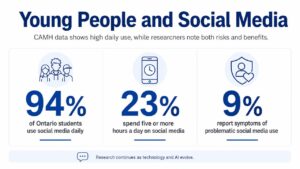
According to the Centre for Addiction and Mental Health’s 2023 Ontario student drug use and health survey, 94 per cent of students u
se social media daily, while 23 per cent spend five or more hours a day on social media.
Dr. Alexia Polillo, a staff scientist at the Centre for Addiction and Mental Health (CAMH) says social media can expose young people to risks such as cyberbullying, harmful content and unhealthy social comparison.
At the same time, it can also provide benefits, including social connection, identity development and access to information.
Polillo said technology is changing quickly, and CAMH continues to study both the risks and benefits of social media for young people.
“Technology and social media use in young people is a complex and nuanced issue, with the evidence continuing to evolve.”
Views: 84