







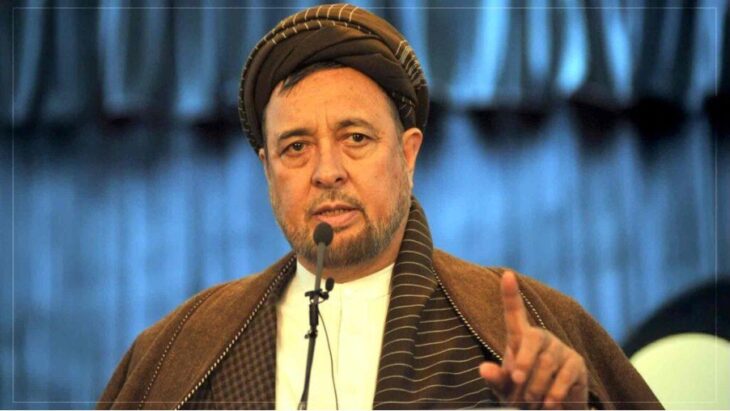

A number of analysts, social media users and residents from various provinces across the country have strongly condemned recent remarks by Mohammad Mohaqiq regarding the Durand Line.
Mohammad Mohaqiq — who held senior positions in the previous government and has been living abroad for nearly five years — said in a television interview that he considers the Durand Line to be the official “border” between Afghanistan and Pakistan.
Regarding the issue, he described Afghanistan’s long-standing historical and national stance as merely the position of Taliban, and claimed that the territory beyond the line is part of Pakistan.
His comments come even though successive Afghan governments and the people of Afghanistan have never accepted the Durand Line as an official border. This position has long been regarded as a national stance, one that the IEA and many Afghans continue to uphold.
Reactions
Qazi Najibullah Jame, a political analyst, told Pajhwok that some figures who deny their Afghan identity are now attempting to challenge what he described as a national Afghan cause: the Durand Line issue.
He said these individuals had pursued discriminatory and ethnic-based policies over the past half-century and had repeatedly served foreign agendas in Afghanistan.
Jame added that they believe such remarks could once again help bring them to power in Kabul through their “masters.”
He said: “We tell these disgraced figures that just as your masters were defeated by the will of the people of this land and saw their dreams buried, you too will be defeated by the people’s will, and these colonial ambitions linked to the Durand issue will also be buried. The nation stands united against such compromising and destructive ideas. You face one geography and one generation, and this nation will never again allow you or your masters to alter governments.”
Many people also reacted on social media.
Journalist and political analyst Sami Yousafzai wrote that the issue and fate of the Durand Line concerns Afghans — not those who do not consider themselves Afghan.
He said that before deciding the fate of any piece of land, one must first be its rightful owner; only then can one speak about its borders and limits.
According to him, ownership is the basic condition for authority over land and property.
Yousafzai added: “The land of Afghanistan belongs to Afghans. The rightful owners have the authority over it, not those who deny being Afghan and chant, ‘We are not Afghan.’”
Shah Hussain Murtazawi, former deputy spokesman for the presidency, also wrote that positions regarding the country’s territorial integrity should be based on political wisdom, collective reasoning and a clear understanding of Afghanistan’s past, present and future — not emotion.
He said policies lacking political rationality do not receive public support.
Sanam Usmani also wrote that the Durand Line is not a personal issue or something open to negotiation; rather, it is tied to national sovereignty and the will of the Afghan people.
He said no politician — regardless of background — has the authority to recognize it as an official border without national consensus and a clear legal basis.
Usmani added: “Such remarks are neither valid nor responsible.”
Ghulam Reza Hosseini wrote that Mohaqiq’s comments were unacceptable.
He stated: “The issue of the Durand Line and the land of Afghanistan is extremely sensitive and vital for our people. This soil has been preserved through immense suffering and sacrifice, and decisions about it cannot be made lightly or abandoned easily.”
Addressing Mohaqiq directly, he added: “Instead of making statements that create public concern and tension, it would be better to explain clearly and responsibly what you mean and on what basis you hold such views. People have the right to know what is being said about the future of their homeland.”
Residents in several provinces also strongly criticized Mohaqiq’s remarks in interviews with Pajhwok.
Sediqullah Mahmood, a resident of Herat, said that decisions on major national issues belong to the Afghan nation, not to individuals seeking personal gain.
According to him, Mohaqiq is among those whose personal opportunism over past decades contributed to the country’s destruction and backwardness.
Mahmood urged the people and government of Afghanistan to condemn such “divisive individuals and those working in favor of the enemy,” and to take action against them. He said the Durand Line is an inseparable part of Afghanistan’s wounded body and cannot be traded, gifted, or sold to Pakistan, a state established eight decades ago.
Haji Gulzar Baloch, a resident of Zaranj city, the center of Nimroz province, said:
“I reject Mohaqiq’s words. Durand belongs to Afghanistan and is part of our land. No Afghan government has officially recognized it. Who is Mohaqiq to make such statements? He should be punished for these remarks.”
Mohammad Awaz Rasouli, a resident of Ghor, also said that the Durand Line has never been accepted by the people of Afghanistan as a border, and that statements by individuals or specific groups cannot represent the historical will and position of the nation.
sa
Views: 1