




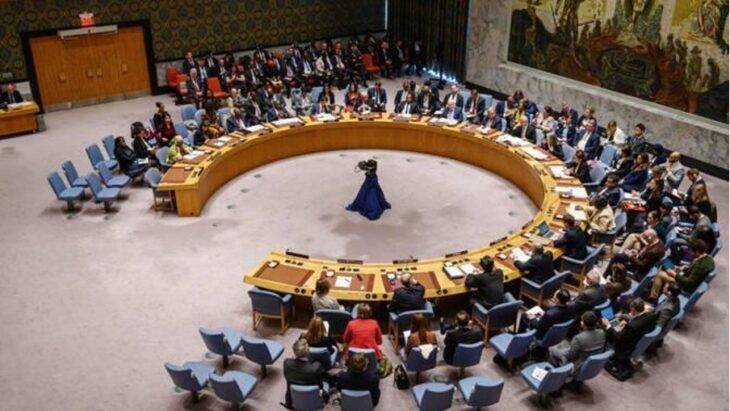
The United Nations Security Council, in a session on Afghanistan, reviewed the country’s humanitarian, economic and security landscape. UN officials and representatives of various member states underscored the need to confront mounting challenges, support livelihoods, and strengthen regional cooperation.
The Council convened its meeting on Afghanistan on Wednesday night.
Georgette Gagnon, Deputy Special Representative of the Secretary-General for Afghanistan and Officer-in-Charge of the United Nations Assistance Mission in Afghanistan (UNAMA), told the 15-member Council on International Human Rights Day: “More than 23 million Afghans — over half the population — will continue to require humanitarian assistance in 2026. Their needs are staggering and growing.”
She added: “The ban on secondary and tertiary education for girls is now in its fourth year, depriving Afghanistan of female doctors, entrepreneurs, teachers, and leaders who are essential to the country today and in the future.”
Gagnon noted that the prohibition on female UN staff entering UN offices violates their human rights and disrupts the organization’s operations.
Addressing the country’s agricultural challenges, she explained that the ongoing ban on opium cultivation—now in its third consecutive year—has driven a 48 percent decline in rural incomes. While an action plan for alternative livelihoods has been developed through the Doha Process, she stressed that additional funding and technical support are urgently required.
Despite relative internal calm, she warned that escalating tensions with Pakistan have resulted in exchanges of fire along the Durand Line and deadly airstrikes.
Tom Fletcher, Under-Secretary-General for Humanitarian Affairs and Emergency Relief Coordinator, cautioned that massive funding reductions have plunged Afghanistan into a severe humanitarian crisis, leaving 17.4 million people facing acute hunger. Consecutive earthquakes, prolonged drought, and groundwater depletion have further eroded livelihoods and essential services.
Echoing the Secretary-General’s call, he urged the de facto authorities to lift restrictions and ensure that female staff can work safely, stating: “Afghanistan needs them.”
Statements from member states
China’s Permanent Representative to the UN, Fu Cong, said Afghanistan continues to confront complex humanitarian and counterterrorism challenges requiring a joint response from the Afghan authorities and the international community.
He emphasized the importance of sustained engagement with the current government and stronger dialogue with Taliban to promote stability. He maintained that the situation in Afghanistan has remained “stable.”
Russia’s Permanent Representative, Vasily Nebenzya, reiterated the need for a realistic and comprehensive approach rooted in objective analysis and balanced assessment.
He called for meaningful and constructive engagement that reflects the needs of the Afghan people, avoids double standards, and is built on precise and trust-based dialogue with the Taliban. Afghanistan, he added, cannot overcome its current crisis without collective and depoliticized international support.
India’s Permanent Representative, Parvathaneni Harish, affirmed his country’s consistent role as a “steadfast” advocate of peace and stability in Afghanistan.
He underscored that coordinated regional and international cooperation is essential and that effective engagement with all relevant stakeholders is critical to advancing peace, stability, and development.
Harish highlighted that humanitarian assistance and capacity-building for the Afghan people remain top Indian priorities. India has implemented more than 500 development-partnership projects—particularly in health, public infrastructure, and capacity-building—across Afghanistan, and this cooperation will continue.
The US Representative alleged that “the Taliban manipulate international aid, ignore the needs of the people, and show no regard for their international commitments.”
He argued that if the IEA obstructs UNAMA’s mandate, the Security Council should consider “restructuring the mission.”
The Representative of Afghanistan urged the Council to adopt a coordinated, benchmark-based framework for international engagement, initiate an inclusive intra-Afghan negotiation process to establish a legitimate governing system, and ensure that the rights of women and girls remain central to all engagements.
He emphasized that the Afghan people have not lost hope and appealed to the international community not to abandon them.
Tanja Fajon, Deputy Prime Minister and Minister for Foreign and European Affairs of Slovenia and Council President for December, stated: “The actions we take — or fail to take — for all Afghan women and girls will shape how we are perceived collectively as a global community.”
The UK Representative noted that British officials traveled to Kabul in October to “press the Taliban to reverse these barbaric decrees,” and said London has committed $201 million for essential life-saving services for the 2025–26 financial year.
Zabihullah Mujahid, chief spokesman for Taliban, said that the rights of all Afghans are guaranteed in accordance with Islamic Sharia.
He also argued that Afghans are not required to adopt interpretations of human rights that vary across societies and countries.
The Representative of Pakistan claimed that “terrorist groups” are active in Afghanistan and, referencing Pakistan’s long-term hosting of Afghan refugees, said Afghans should return to their country “with dignity and in an orderly manner.”
Iran’s Representative stated that Tehran “cannot and will not be able to continue bearing alone the heavy burden of hosting more than six million Afghans.”
Kazakhstan’s Representative also voiced regional concerns.
sa
Views: 1