





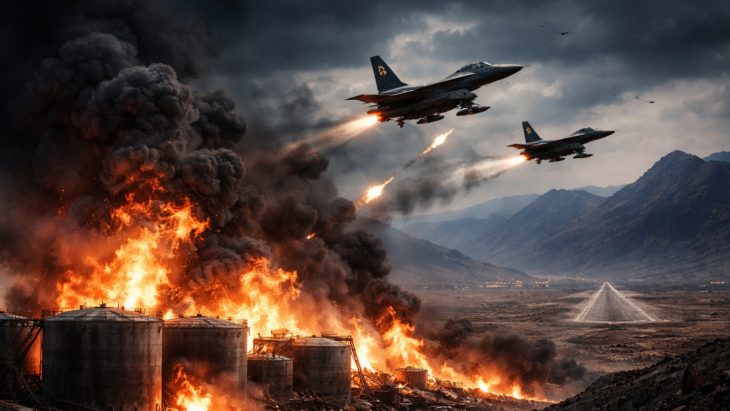

Pakistani jets once again bombed parts of Afghanistan. They targeted civilians and Kamrair’s oil reservoir. Pakistan’s latest military campaign against Afghanistan has entered a dangerous new phase, and the motives behind it are becoming increasingly difficult for Islamabad to conceal. Last week, Babar Awan—a prominent Pakistani human rights advocate and member of parliament—publicly confirmed what Afghan analysts have been warning for months: Pakistan’s repeated violations of Afghan sovereignty are tied directly to General Asim Munir’s promise to President Trump that he would secure Bagram Airbase for the United States. Trump has stated that he wants Bagram to monitor China, but many Afghan observers argue that the deeper strategic beneficiary is Israel. For Netanyahu, both Bagram and Shindand would have been pivotal assets in the unfolding confrontation with Iran.
Pakistan’s military establishment has long survived by renting itself out to great powers in exchange for financial and political patronage. This pattern—visible from the Cold War to the War on Terror—has enriched the army while impoverishing ordinary Pakistanis. The current crisis is simply the latest iteration of this model: Islamabad seeks to appease Washington, secure external funding, and reinforce the army’s domestic dominance, even at the cost of regional stability.
General Munir appears unbothered by the internal instability his actions may provoke. In fact, chaos strengthens his grip to further suppress political figures and people who oppose his policies. A former Pakistani army officer recently claimed on his X page that Munir even sought permission from President Trump to use nuclear weapons against the Taliban—an alarming indication of the general’s psychological disposition and the danger it poses to the region. Munir’s campaign is not only about Bagram; it is also about destroying the weapons currently held by the Taliban. In recent weeks, Pakistani airstrikes have targeted multiple Afghan military bases and weapons depots. This strategy aims to weaken the Taliban’s long‑term defensive capacity and reshape the regional balance of power.
This escalation must also be viewed in the context of Pakistan’s Strategic Pact with Saudi Arabia, under which Islamabad may be drawn into a broader confrontation with Iran. Analysts argue that Pakistan’s military posture—its alignment with U.S. interests, its willingness to strike Afghan territory, and its deepening security ties with Riyadh—could position it as a frontline actor in any Saudi‑Iran escalation. It could enter Iranian conflict in return for money.
Pakistan’s aggression comes at a time when the Taliban administration has made notable progress on several fronts. Despite legitimate criticism regarding girls’ education and women’s rights, the government claims to have performed unexpectedly well in economic management and development. Kabul says it has launched major water‑management projects, funded road and electricity infrastructure, strengthened ties with neighboring states, and generated record domestic revenue. It also managed the mass return of refugees expelled by Iran and Pakistan with relative administrative competence. These achievements, however fragile, are now threatened by Pakistan’s escalating hostility.
Behind the rhetoric of counterterrorism and border security, Pakistan is also attempting to carve out a safe corridor for ISK and remnants of the NRF to re-enter Afghanistan. The objective is clear: ignite a new internal conflict that would drain the Taliban’s resources, fracture Afghan society, and create conditions for foreign leverage. If Kabul and Kandahar fail to manage this situation—especially in the absence of adequate ammunition and air defense—the country could slide toward civil war. Everything the Taliban have built over the past three years could unravel.
The Taliban have shown restraint, repeatedly signaling openness to dialogue through third‑party mediation. But Pakistan’s actions and the narrative pushed by its military establishment reveal a deliberate intent to destabilize Afghanistan. This strategy echoes the infamous words of Akhtar Abdul Rahman, the architect of Pakistan’s Afghan policy during the 1980s: *“Kabul must burn for Islamabad to feel secure.”* The current campaign is simply a modernized version of that doctrine.
To avoid strategic paralysis, the Taliban must take several steps to establish minimal deterrence against any aggressor. They need to deepen engagement with regional powers—China, India, Iran, Russia, and Central Asian states—to secure defensive weapons and political backing. They must relocate their existing weapons stockpiles into secure underground tunnels, many of which already exist across the country. Any response to Pakistan must be measured, targeted, and strategic, focusing strictly on military and intelligence assets in Punjab, GHQ Rawalpindi, and Islamabad—not on civilians. If Pakistan continues to strike Afghan weapon depots, the Taliban may feel compelled to respond by targeting Pakistani military garrisons and the political elites who authorize aggression.
Pakistan today represents an escalating threat not only to Afghanistan but also to Iran. Its willingness to destabilize neighbors for external patronage, combined with the ambitions of its military leadership and its commitments under the Saudi strategic framework, has created a volatile situation with regional implications. Afghanistan stands at a critical juncture. The choices made in the coming weeks—by Kabul, Kandahar, and regional capitals—will determine whether the country preserves its hard‑won stability or is dragged back into the cycle of conflict that Pakistan’s generals have relied on for decades.
The views expressed in this article do not necessarily reflect Wesal TV’s editorial policy.
Views: 0