






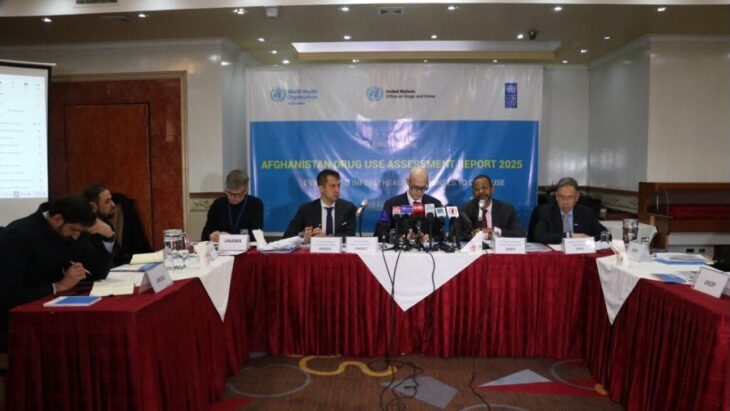
A new publication by the United Nations Office on Drugs and Crime (UNODC) finds that drug use in Afghanistan remains dominated by traditional substances, while the use of synthetic drugs and misused pharmaceutical medications is rising.
The UNODC assessment, released today (Sunday), shows that men most frequently cited cannabis (46%) and opium (19%) as the drugs used in their communities, while “Tablet K” (11%) and methamphetamine (7%) were also reported.
This publication is the third and final volume of UNODC’s National Survey on Drug Use in Afghanistan (NSDA), funded by UNDP. It builds on two earlier health-focused volumes: one mapping treatment facilities for substance use disorders, and another assessing high-risk drug use. The last national survey of drug use in Afghanistan was conducted in 2015.
The findings highlight the economic burden of household dependence. The cost of substances such as methamphetamine and opium can exceed a full day’s wage. For instance, one day of methamphetamine use can cost up to 138% of a casual worker’s daily income or 67% of a skilled worker’s wage.
Respondents linked ongoing drug use primarily to poverty, unemployment, and financial hardship. Other contributing factors included physical pain and ill health, psychological distress, family challenges, and dependence. Overall, the results show strong links between substance use and broader socio-economic pressures.
Oliver Stolpe, UNODC Regional Representative for Afghanistan, Central Asia, Iran, and Pakistan, said: “Our findings show drug use is closely linked to poverty, unemployment, and untreated health needs. Effective responses must integrate treatment and harm reduction with primary health care, mental health support, and social protection to reduce harmful self-medication and support recovery.”
Stephen Rodriques, UNDP Resident Representative in Afghanistan, added: “This national survey provides a clear picture of drug use realities in Afghanistan and the challenges people face. The findings will inform stronger policies and programs to address the health dimensions of drug use, support recovery, and tackle root causes, including lack of jobs and economic opportunities. It also demonstrates what UN agencies can achieve when they collaborate, leveraging strengths to deliver better outcomes for the Afghan people.”
Earlier findings from UNODC’s High-Risk Drug Use Survey highlighted health risks associated with Afghanistan’s changing drug landscape. The survey found that 8% of respondents had injected drugs in their lifetime, and among these, over 75% reported sharing needles, while around half reported inconsistent access to sterile equipment—pointing to gaps in harm reduction coverage.
A gender gap was also evident: only 29% of women reported accessing treatment, compared with 53% of men, underscoring the need to expand women-specific services.
According to the assessment, the Islamic Emirate of Afghanistan (IEA) reports treating large numbers of people who use drugs.
UNODC’s first volume, mapping treatment facilities, shows major gaps in distribution, accessibility, quality, and gender coverage. Nearly two-thirds of facilities serve men only, 17.1% serve women only, and across the 32 provinces surveyed, just over one-third provide services for women. The mapping also noted ongoing constraints, including shortages of qualified health professionals and insufficient infrastructure. Meanwhile, the IEA continues to provide treatment at centralized and provincial centers.
Georgette Gagnon, Officer in Charge of UNAMA and Deputy Special Representative of the UN Secretary-General in Afghanistan, said: “These studies are essential to guide responses by the de facto authorities, donors, UN agencies, and partners to this extremely serious problem.
The study calls for a people-centered response: putting people first by ending stigma and discrimination surrounding drug use. Prevention remains the most essential and cost-effective strategy to halt drug flows, protect communities, and reduce demand.”
Based on all three volumes and international standards, UNODC recommends expanding voluntary, rights-based treatment and harm reduction services for both men and women. This should include investments in health worker training and minimum facility standards, linked to primary health care, mental health and psychosocial support, social protection, and employment assistance to address poverty, pain, and distress. Interventions should also reflect provincial drug market patterns and reduce household burdens through family-centered services and livelihood support for people in treatment.
Views: 2