







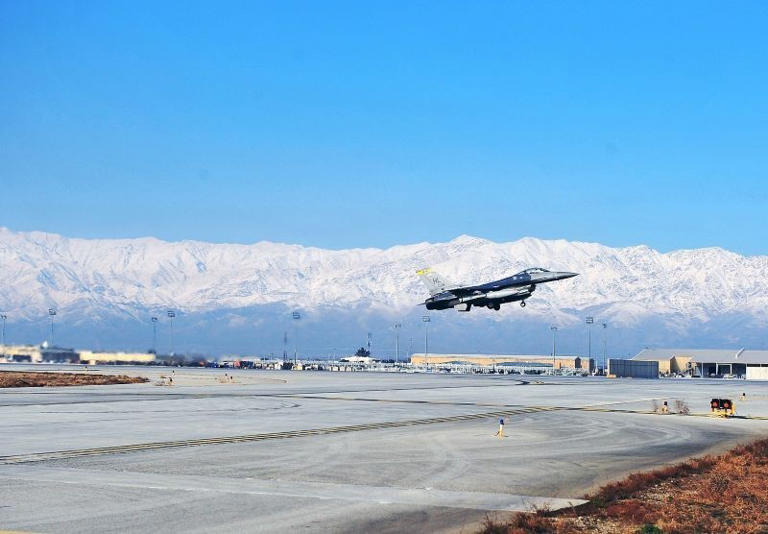
Trump’s latest ordeal with the Taliban comes down to one pressing question: Will they hand over Bagram Air Base, or is this a high-stakes gamble for political recognition?
Nearly 24 years ago, in September, I vividly remember one hot night at home. My father, along with a few male guests, sat on the roof, brimming with anticipation, waiting to listen to the Voice of America’s Pashto news hour—the only way to catch news from the outside world. “Bring the radio quickly!” my father called. I was pretty young, and with an urgency, I dashed to hand him our old, battered radio.
Unlike today, where social media and AI deliver news from around the world with a single click, back then, we relied on that small device for every important update.
After the September 11 attacks, like many Afghan families, my parents were gripped by uncertainty. Night after night, they tuned in to the radio, clinging to any news that might signal we were safe.
That specific night, looking for the destiny of Afghanistan, the presenter asked the Taliban’s former leader, Mullah Mohammad Omar—perhaps in a rare interview given to the media—“Why don’t you expel Osama bin Laden?” His own words, calm and chilling: “This is not an issue of Osama bin Laden…”
In response to the September 11 attacks, George W. Bush declared that the US “will make no distinction between the terrorists who committed these acts and those who harbor them.” By October 2001, as US forces prepared to strike Afghanistan, Bush issued a stark ultimatum to the Taliban: hand over all al-Qaeda leaders hiding on Afghan soil, or “share in their fate.” The United Kingdom’s Prime Minister Tony Blair publicly stood “shoulder to shoulder” with Bush in the “war on terror,” alongside other allied nations, and toppled the Taliban regime.
On Thursday, during Donald Trump’s three-day UK trip, Trump again blasted Biden’s 2021 chaotic withdrawal—this time hinting at a potential deal with the Taliban for a US return to Bagram airbase. Except for a few countries like China and Russia, after four years, the US has still not formally recognized the Taliban government that took power following its troop withdrawal.
“We’re trying to get it back because they [Taliban] need things from us,” said Trump. “We want that base back.”
The Taliban has dismissed the demand to hand over the 75-year-old Soviet-built Bagram, a strategic airstrip just an hour flight to China’s Xinjiang province. The Taliban statement said, “Afghanistan’s independence and territorial integrity are of the utmost importance.”
While rejecting Trump’s warning, the Taliban on a social media platform wrote, “BAD THINGS ARE GOING TO HAPPEN!!!.”
Bagram retains its strategic significance, partly due to China’s expanding nuclear testing capabilities and the base’s key access to Central Asia, even Iran.
Over two decades of U.S.-NATO presence, Bagram evolved into a major hub with an 11,800-foot runway for bombers and heavy cargo planes. Destroyed during the Afghan civil war, the American was rebuilt with a second runway and became the headquarters for thousands of American troops leading counter-terrorism operations against the Taliban and ISIS-K, while also serving as a base for construction projects involving both international and local contractors.
The airfield also housed a notorious prison, from which thousands of inmates were released the day after the Taliban re-seized Kabul.
Fasihuddin Fitrat, Chief of Staff of the Armed Forces of Taliban, said that we will not negotiate, even” Not an inch of our soil.”
Meanwhile, the Taliban’s chief spokesman, Zabiullah Mujahid, also rejected it, saying the Americans should respect the Doha peace accord of 2020: “Accordingly, it is once again underscored that, rather than repeating past failed approaches, a policy of realism and rationality should be adopted.”
Bagram has long served as America’s strategic foothold in the backyards of its biggest rivals. Situated near China, along Russia’s southern border, and close to Iran, the base offers rapid access and intelligence capabilities, and monitoring unmatched elsewhere.
While Trump’s predecessor Joe Biden remarks to “maintain over-the-horizon capacity to suppress future threats,” without Bagram, U.S. options shrink, leaving it dependent on distant bases or exposed Gulf positions.
Over the past two decades, Afghanistan made notable progress across many areas of life—progress that was wiped out in just 11 days with the collapse of the US-backed Afghan republic government.
Since the Taliban’s return to Kabul in August 2021, four years have passed in the blink of an eye. Under Taliban rule, Afghanistan has grown increasingly invisible on the global stage.
Many of Afghanistan’s professionals have fled, while billions in national assets remain frozen by the United States; only limited humanitarian cash packages trickle in. Girls’ schools are banned beyond the sixth grade, a major factor in the West’s refusal to recognize the Taliban politically.
Meanwhile, nearly half of the country’s 42 million people live below the poverty line. Food insecurity is rising, and climate change is relentlessly battering provinces—including Kabul—where water shortages are becoming increasingly severe, according to UN reports.
Neighboring countries, including Pakistan and Iran, have forcibly returned millions of Afghans to the shattering, fragile economic development. Unemployment remains high, pushing many youths onto perilous migration routes abroad. Deadly natural disasters—such as the 2022 quakes and the more recent one in Kunar that killed more than 2,000—have deepened the suffering, even for returnees.
Afghanistan, which is caught between nuclear-armed neighbors and serving as an arena for superpower rivalries, Afghanistan’s civilians continue to pay the highest price—whether through bombs or hunger.
Trump’s push to retake Bagram Air Base—set against China’s nuclear build-up in Xinjiang—risks destabilizing an already fragile region and could once again turn Afghanistan, after decades of war and instability, into a flashpoint in US-China and regional rivalry. “China respects Afghanistan’s independence, sovereignty, and territorial integrity,” Chinese foreign ministry spokesman Lin Jian said on Thursday.
Abulfazl Zohrevand, an Iranian MP, warned that if the U.S. pushes to return to Afghanistan, “Bagram could turn into a graveyard for American soldiers.”
Trump, however, was blunt: “One of the reasons we want the base is, as you know, it’s an hour away from where China makes its nuclear weapons,” he declared at a joint press conference with British Prime Minister Keir Starmer in London.
Trump’s latest announcement may carry messages for regional powers, but it offers little to Afghans themselves. As victims of post-Cold War rivalries, Afghans fear once again being caught in the crossfire of a U.S.-China confrontation, asking: When will they finally live in peace? I recall a top Afghan-American figure once remarking that “Americans in and out don’t require anyone’s permission.”
Washington’s rhetoric, echoed in, raises questions about the Doha Peace Accord with the Taliban. They are unlikely to easily yield to Trump, having already sought economic and trade openings with the U.S.
Over the past 20 years, billions in U.S.-NATO funds flowed into Afghanistan, fueling systemic corruption while leaving much of the nation’s infrastructure underdeveloped.
Any new deal over Bagram risks becoming a diplomatic trap. If the Taliban softens too much with Washington, it may be seen as selling out heavily valuable capital. Muhejer Farahi, deputy of the Ministry of Information and Culture, wrote a Pashto poem: “Your mind is still not at peace; The one who struck me has a head of stone.” Trump’s first call to a Taliban official in 2020: “You[Taliban] are tough people.”
Despite sitting on an estimated $1 trillion in untapped mineral deposits, Afghanistan remains one of the world’s poorest nations. In 2017, Trump admitted that one reason for America’s continued presence was to pursue mining interests. Today, China is taking the lead in that sector. I once asked a teen from Chardara district of Kunduz—whose brother was killed in the 2015 U.S. airstrike on Kunduz regional hospital—what mattered most to him. His reply was: “I fear the bombs, and I fear hunger.”
The views expressed in this article do not necessarily reflect Wesal TV’s editorial policy.
Views: 59