







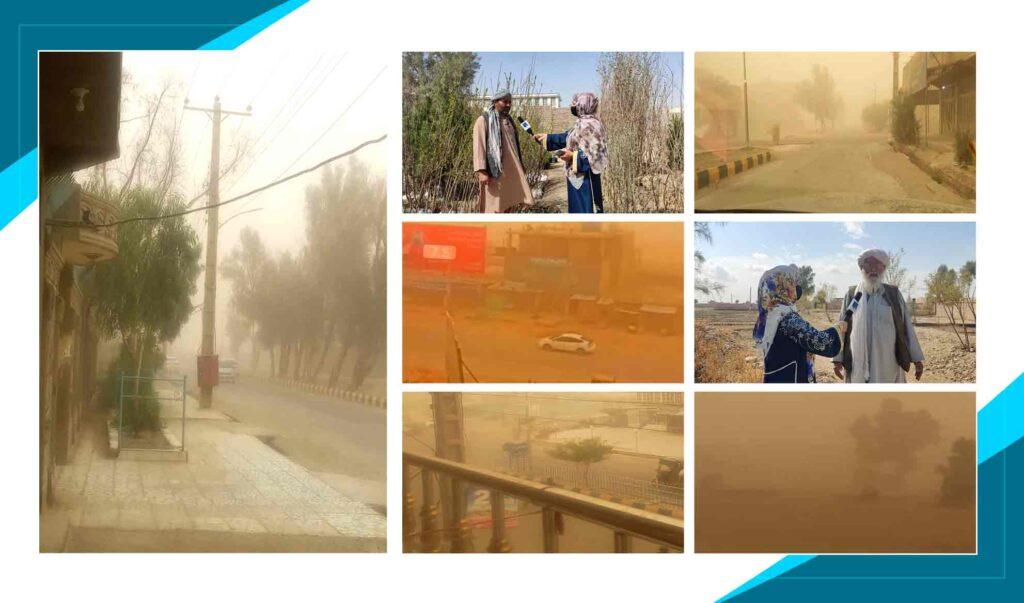
In northwestern Nimroz province where rainfall has declined due to climate change and most of the land is arid and sandy, some residents in Zaranj, the provincial capital, say seasonal 120-day wind has a destructive impact on their lives.
The moisture-laden winds typically blow from late May to late September, with an average speed of 80 to 120 kilometres per hour.
A health expert recommended increased use of face masks during this period. He said food should always be covered and drinking water must be boiled.
Environmental experts, meanwhile, emphasise the planting of drought-resistant trees and promoting drip irrigation systems.
Residents: 120-day storms cause serious problems
Imran Naroei, a shopkeeper in Zaranj city, told Pajhwok Afghan News: “Due to drought, all green lands have dried up and vegetation is now very scarce. In recent years, these dust storms have become a torment. All the dust enters our homes and brings germs along with it.”
He added: “These storms and the rising dust contaminate fruits and vegetables. Many of us suffer from respiratory problems like asthma, which is very distressing.”
Another local, Hafizullah, who runs a shop, said he has to clean his goods at least ten times a day, yet dust continues to settle on them. Sometimes, due to the intensity of the storm, markets are deserted for at least three days a week, making it difficult for people to go shopping.
He said: “Nimroz used to be green and was known as Asia’s grain warehouse, but now it has become a city of dust and storms. If green spaces were developed, the amount of dust would reduce.”
He urged the caretaker government to take steps to reduce drought and develop green spaces in northern Zaranj.
Meanwhile, Parvin, a 30-year-old woman who works as a cleaner in people’s homes to earn a living, said: “Zaranj now has neither water nor greenery. I sweep houses every day, but the dust never ends. I breathe in the dust, and now I have shortness of breath.”
She explained that cleaning the dust from walls and carpets takes hours and leaves her body aching.
“Some days, the storm and air pollution are so severe that if the windows are open, sand falls on our heads, but if we close them, we suffocate from the heat,” she added.
Hashim Basri, another resident of Nimroz, said that in addition to other problems, the storm also causes power outages and disruptions to telecommunications networks.
Haji Mohammad Yousuf, a 50-year-old resident, said: “This year’s storms are so intense that people can’t even see each other’s faces, and drivers have to turn on their headlights during the day. As shopkeepers, we clean our shops several times a day. These storms have ruined our farmlands.”
He added: “The winds of Nimroz have existed for over a century, and these sand dunes have always been here. But when the area was lush and full of water, the sand didn’t reach the city. Due to consecutive droughts, Nimroz has turned into a barren, dusty region.”
Health expert: Dust storms cause diseases
Farhad Hamdard, an internal medicine specialist in the province, said the storms could carry microbes and spread microbial and respiratory illnesses as well as allergies.
According to him, all city residents, particularly children, were at high risk of diseases.
He noted that in recent months, most of his patients were children suffering from diarrhoea and intestinal infections – illnesses caused by breathing polluted air and consuming food contaminated with dust.
He stressed that wearing masks during storms is essential, as the wind easily carries germs that can quickly enter food and water.
He advised parents to boil water before drinking to prevent children from contracting infectious diseases.
Environmental experts: Harmful effects of winds must be curbed
Mohammad Faisal Wahedi, an environmental expert in Nimroz, said the 120-day winds, once merely a seasonal phenomenon, have now – due to climate change and repeated droughts – turned into persistent, powerful storms.
He explained that the loss of forest cover has allowed these storms to cause serious damage to agriculture, livestock, and people’s livelihoods, thereby increasing economic and social pressures.
He suggested several measures to mitigate the harmful effects of the winds: protecting the remaining trees, restoring forests, expanding green spaces, and linking the Kamal Khan dam’s irrigation channels to various parts of the province to supply water and support plant growth.
Meanwhile, Eng. Enayatullah Sarwari, another expert in the province, said that to combat this issue, underground water sources should be properly managed, drought-resistant trees planted, and farmers trained in drip irrigation techniques.
Negative impact of the 120-day winds on agriculture & plant cultivation
Asadullah, an official at the Agriculture, Irrigation and Livestock Department, said the winds have extremely negative effects on farming and plant cultivation in the province.
He explained: “The start of these winds coincides with the planting and harvesting seasons of agricultural products. They cause soil erosion and deplete the land of its minerals. When the soil is impoverished, plants cannot absorb nutrients and grow – they eventually become dry.”
According to the department, due to wind erosion and recent droughts, much of the land has become unsuitable for farming.
Public Works Department
Jan Mohammad Badri, Head of the Nimroz Public Works Department, said the seasonal 120-day winds cause the movement and accumulation of drifting sands, severely damaging roads and often blocking them.
He added that the department was responsible for maintaining inter-provincial roads, national highways, and regional routes. To combat the sand build-up in vulnerable areas, daily and ongoing clearing is carried out with bulldozers according to a fixed schedule, to prevent road closures to traffic.
kk/ma
Views: 2