







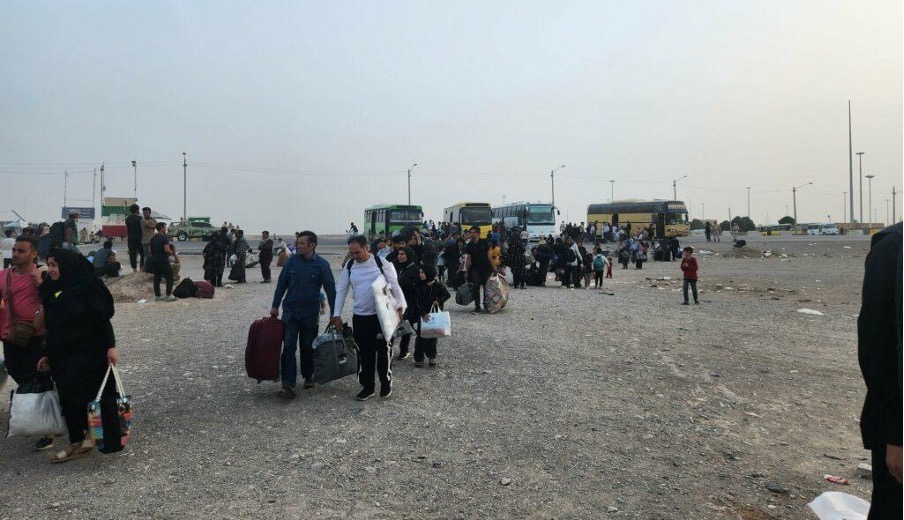
As the deportation of Afghan migrants from Iran intensifies, thousands of exhausted returnees are arriving back in Afghanistan — bringing with them heartbreaking stories of pain, suffering, and unspoken hardship.
Alongside the anguish of return, many speak of harrowing experiences in Iranian detention camps — facilities overwhelmed by overcrowding, unbearable conditions, and mistreatment that turned their days into a nightmare.
Hasibullah, a young Afghan who legally entered Iran with a passport and visa, tearfully recounted his ordeal to a Pajhwok Afghan News reporter: “They tore up my passport and ID. Right before my eyes, they killed a sixteen-year-old boy. The cost of returning used to be two million tomans; now they demand ten million per person.”
After spending over a week in Iranian camps, Hasibullah described horrifying scenes: “I saw several corpses of Afghan migrants — people who were either killed without reason or left under the scorching sun.”
He added, with tears in his eyes, that young men were frequently beaten in the camp where he was held. Hasibullah urged the Iranian government to end what he called its oppression of Afghans who had migrated out of sheer desperation.
Zabihullah, another recently deported Afghan from Balkh province, who also returned through Islam Qala crossing, shared a similarly painful story.
He explained that the detention camps in Iran are overwhelmed and can no longer accommodate the growing number of deportees.
According to him, a facility designed for 1,000 individuals now holds over 2,000 — all in sweltering heat and degrading conditions.
Zabihullah, who had also entered Iran legally in search of work, said he was beaten by police during his arrest and wasn’t even allowed to take his clothes or personal documents.
“I spent two days and nights in the camp,” he said. “During that time, we weren’t given even a piece of bread. Despite the extreme heat and overcrowding — with women and children among us — police treated Afghans like animals.”
He further stated that Iranian security forces threatened them not to speak with the media, warning that doing so would lead to further repercussions.
But returning to Afghanistan has not ended their ordeal.
Rahim Shah, who arrived in Islam Qala with his elderly parents, described continuing difficulties: “It’s been two days, and we still haven’t been able to get to Herat city. Everyone has to stand in line for food. My elderly parents couldn’t stand, so they didn’t receive any. I only managed to get my own portion. I have no complaints against strangers — I’m disappointed by our own people. Why is there so much disorganization in assisting returnees?”
Despite the challenges, Afghan officials have pledged to support the returnees and ensure a dignified life inside the country. They say comprehensive measures have been taken to manage the situation effectively.
These include the establishment of registration and biometric centers, the provision of medical and transportation services at the Islam Qala border, and the construction of dedicated housing for returnees in 25 provinces.
Maulvi Ahmadullah Muttaqi, head of Herat’s Information and Culture Department and chair of the Public Information Committee of the Commission on Migrant Affairs, told Pajhwok that these efforts are ongoing daily in coordination with charitable organizations and the commission.
He noted that each returnee is being provided with food, medical care, and a cash allowance of 2,000 afghanis to cover travel expenses to their final destination.
Meanwhile, Maulvi Asif Asif, head of the Commission’s Transport Committee in Herat, assured that round-the-clock efforts are being made to resolve transport issues, enabling migrants to return to their home provinces as quickly and smoothly as possible.
These stories represent only a fraction of the immense suffering endured by thousands of Afghans affected by this latest wave of deportations.
From the detention camps of Iran to the long lines at Afghanistan’s border checkpoints, Afghan migrants remain caught in a relentless cycle of hardships — their eyes still searching for a future beyond uncertainty.
sa
Views: 2