




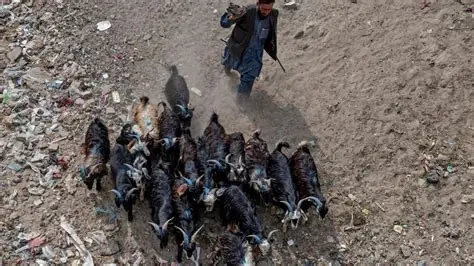
In the barren plains and treeless slopes of Daikundi’s mountains—where lush pastures once sustained thousands of livestock—a different picture of rural life is now painted: hungry herds and desperate herders.
As drought continues and rainfall declines in Daikundi, hundreds of herding families find themselves in dire conditions.
Residents of the province say that due to the severe shortage of fodder and the drying up of pastures, they’ve been forced to sell their livestock at low prices or abandon livestock farming altogether.
In Daikundi, people primarily earn a living through livestock in addition to farming. They are urging the government and aid organizations to take urgent and effective measures to provide fodder and manage the drought crisis to prevent the collapse of this traditional livelihood.
Noor Ahmad, who for years herded goats and sheep in the green valleys and meadows of Pitab in Miramor district of Daikundi, used to find joy in the grassy mountain paths and the flowing waters of the valleys—symbols of vitality and life.
Now, most of these meadows and valleys convey a different message—one of despair. The once-thriving herd of goats and sheep that kept his family’s economy running has diminished, and that economic cycle is now faltering.
Ahmad, who has been a farmer and primarily a herder for over ten years, used to support his seven-member family through livestock. But he says the drought and lack of rainfall have led to an unprecedented decline in animal fodder.
He added: “I used to have a lot of cattle and livestock. I would sell many each year, which covered household expenses and allowed me to save money. There was abundant grass—we cut it from the valleys, and every day we took the animals to graze in the mountains. But this year, due to lack of rain, there is very little fodder, and there’s nothing in the mountains or plains to fill the animals’ bellies.”
He continued: “When it didn’t rain at the start of the year, I realized it would be a tough one. I sold several of my goats and sheep so that the remaining ones might survive. Now, there’s nothing in the mountains—our children take the livestock out hungry and bring them back hungry. I’ve sold several more animals at half price.”
He explained that people are no longer interested in buying animals for raising because there’s no proper feed available. For this reason, herders who can no longer afford to maintain their animals have been forced to sell them at throwaway prices.
He calls on the government to support Daikundi’s herders in providing animal feed and take urgent steps to prevent the collapse of this traditional profession.
Ahmad’s story is not unique. Qudrat Baqiri, another herder from the Sangtakht-Bandar district of Daikundi, is facing a similar situation. He says: “Drought has severely reduced livestock feed. When there’s no pasture or water, we’re forced to sell our animals. The price of fodder has doubled—we can’t afford it.”
It’s not just a fodder issue—providing drinking water for livestock has also become a new challenge. Baqiri says that, to avoid excessive water use, herders are now feeding their animals with leftover water from washing dishes and clothes—something once unimaginable.
He adds: “We ask the government and organizations to distribute oilcake and fodder to us. A solution must be found so our animals don’t die.”
But this isn’t just the problem of one family or one village. Ali Janati, a tribal elder from Daikundi, speaks of the drastic decline in people’s incomes and says:
“Most families in this province earn their living by raising and selling livestock. But with the lack of rainfall and ongoing drought, this traditional profession is on the verge of collapse.”
He added that climate change has negatively impacted both farming and herding. There are no pastures left, and there isn’t even enough water for people to grow animal fodder. Many have already given up on herding.
Janati emphasizes that the loss of these two key income sources—farming and herding—has put Daikundi in an unprecedented economic crisis. According to him, this year the mountain pastures and plains have disappeared, and there’s not even enough water to cultivate fodder crops.
This tribal elder also urges the government to seek serious strategies and alternative options for Daikundi’s herders, to ease the pressure of poverty on the population.
Environmental experts
Mohammad Hamdard, an environmental activist in Daikundi, sees the situation as far more critical than it may appear at first glance.
He describes the drought not just as an environmental crisis but as a “socioeconomic disaster” that threatens the survival of livestock-dependent rural communities.
Hamdard says: “Drought has reduced incomes, increased costs, destroyed assets, and triggered waves of unemployment and migration. Villages that relied on traditional livestock farming are now facing the collapse of their social and economic structures.”
He stressed that the reduction in rainfall and drying up of pastures threaten the foundation of traditional livestock farming and create a chain of problems—from animal nutrition to household economy and rural social structures.
He outlined the multi-layered consequences of this crisis and noted that Daikundi is largely a rural society whose economy is based on livestock. Therefore, the drought leads to income loss, higher maintenance costs for livestock, destruction of household assets, unemployment, migration, reduced local production and food security, and serious social and psychological impacts.
This environmental activist believes that a long-term solution to this phenomenon requires a comprehensive and sustainable multi-dimensional approach based on education, natural resources, livestock breed improvement, water management, and community participation.
He stated: “Modernizing the livestock sector, sustainable resource management, water resource storage and management, cultivation of drought-resistant crops and fodder, improving veterinary services, access to livestock insurance, strengthening herders’ knowledge and awareness, and diversifying income sources are among the appropriate strategies to counter climate impacts on livestock farming.”
He emphasized that the government, local institutions, and the people must work together to save the livestock sector.
Meanwhile, officials from Daikundi’s Agriculture Department confirm that drought has had serious effects—reducing fodder resources, increasing livestock diseases, and drastically lowering livestock prices. These issues have directly impacted the livelihoods of thousands of rural families in the province.
Kazem Kazemi, Head of Livestock and Animal Health at the Daikundi Agriculture Department, stated that drought has dealt a major blow to herders—leading to shortages in fodder, reduced grazing areas, lack of sufficient water, outbreak of animal diseases, and a drop in livestock prices. Altogether, this has weakened the herders’ economy.
He added that the department, in coordination with veterinary clinics, has taken necessary measures to control animal diseases and has submitted reports to partner organizations and the Ministry of Agriculture.
Kazemi also noted that this year, to combat drought-related diseases, 120,000 doses of Peste des Petits Ruminants (PPR) vaccine for small ruminants have been administered in Daikundi with the help of the United Nations Food and Agriculture Organization (FAO).
He further said: “Partner organizations in the agriculture sector have implemented small-scale projects to support poor families. However, regarding the drought, they have only conducted assessments on the livestock sector and have yet to take practical action.”
Daikundi is one of the provinces where the vast majority of people rely on two main pillars of livelihood—agriculture and livestock. Now, with the degradation of pastures, lack of water, and unprecedented drought, these two traditional professions are on the brink of collapse, pushing thousands of families into hardship.
Views: 3