




With a worrying decline in groundwater levels in Kabul, environmental experts warn that any delay in launching the Panjshir Water Transfer Project could push the capital into a severe water crisis.
The Ministry of Energy and Water (MoEW), however, says technical studies, surveys, and designs for the project are complete and have been submitted to the leadership of the government for approval.
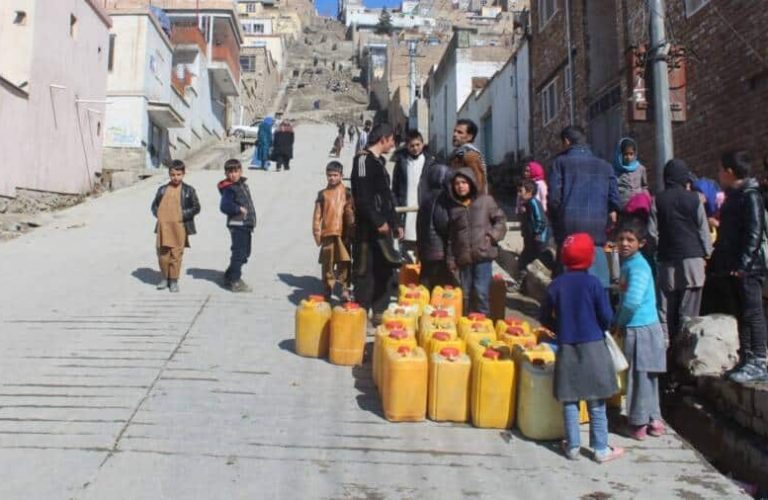
Uncontrolled population growth, a lack of effective water resource management, and declining groundwater levels has created one of Kabul’s most serious environmental challenges. In many areas, families must wait in long lines for water tankers or travel great distances to meet their basic water needs.
The United Nations Assistance Mission in Afghanistan (UNAMA) reported on June 14 that nearly one-thirds of the Afghan population lacks access to clean drinking water, while more than 10 million people rely on unsafe and contaminated sources.
Despite some improvements, the crisis continues to severely impact rural communities—especially women and children. The UN has pledged support to help alleviate Afghanistan’s water crisis.
Environmental Experts: Mismanagement, not climate clone, driving the crisis
Najibullah Sadeed, an environmental expert, told Pajhwok Afghan News that Kabul’s water crisis is more a result of poor management than climate change. He noted that the city’s population has surged from below two million in 2000 to over six million today, placing unprecedented pressure on water supplies.
“Kabul has expanded 4.5 times without any planning,” he said. “This uncontrolled growth has caused a continuous drop in groundwater levels.”
Sadeed noted that surface water sources have completely dried up, while deep groundwater sources are also in critical condition. As of 2019, around 400 hectares of greenhouses in Kabul used underground water for irrigation. He also pointed to excessive water usage by car washes, factories, and swimming pools as evidence of poor management.
He emphasized that importing water from outside the city—particularly from the Panjshir River basin—is the only viable short-term solution. He also cited the Shah Tut Dam project, which could supply drinking water to 2.2 million people, as another urgent priority. Without action on these projects, he warned, the crisis will deepen and lead to broader social problems.
Groundwater depletion reaches critical levels
Seyyed Mohammad Sulaimankhel, a specialist in climate and environmental issues, echoed these concerns. He said Kabul’s groundwater levels are falling by more than two meters each year and could be exhausted within five years.
“This is extremely serious for a capital city,” he said. “In the past, snow and rainfall naturally recharged the groundwater. But due to climate change, warmer temperatures are increasing water demand while reducing replenishment.”
He added that poor management of surface water and the lack of systems to redirect runoff into aquifers have worsened the problem.
He cited global climate reports predicting that Afghanistan is on a path toward severe desertification over the next century.
Sulaimankhel urged immediate investment in long-term solutions—especially groundwater recharge systems and alternative water sources.
He backed the Panjshir Water Transfer Project as a critical step and warned that delays could allow “water mafias” to exploit the crisis by selling filtered water at high prices.
He also advised public awareness campaigns to discourage wasteful use of drinking water, limit well-drilling, relocate beverage factories out of the city, and reduce overall pressure on Kabul’s water reserves.
Panjsher water transfer project
According to the MoEW, the Panjshir Water Transfer Project would deliver two cubic meters of water per second (2 m³/s)—providing clean drinking water to about two million Kabul residents.
The $170 million project involves transferring water from the Panjshir River (Bazarak) to the Tarakhel area in Kabul. Construction is expected to take three years.
In February, Acting Water and Energy Minister Mullah Abdul Latif Mansoor announced that the project’s survey and design had been completed, and construction would begin once funding and resources are secured.
Kabul residents face daily hardships to find water
Sher Mohammad Hamdard, a resident of Kabul’s District 5, described how difficult was waiting hours to fetch water home: “It takes an hour just to bring water home,” he said. “We load barrels onto handcarts and walk long distances. It wastes a lot of time.”
He urged the government to establish residential water pipelines to supply clean water directly to homes.
Adam Khan, from the Arzan Qimat area, reported that most homes in his neighborhood are without water. “In our alley, only two or three houses have running water,” he said. “The rest rely on handcarts and walk long distances. The government must bring water from Panjshir and Shah wa Aros and set up a reliable water supply system.”
Government’s Plans and Warnings
Qari Matiullah Abed, MoEW spokesperson, confirmed that water levels in some basins have dropped by up to 90%, and Kabul’s groundwater situation is nearly critical. The ministry has developed both short- and long-term strategies to address the issue.
In the short term, the ministry is working on equitable groundwater use and has built small dams around Kabul to capture surface water. “Large national projects take time,” Abed said, referring to the Panjshir project. “Technical studies and designs are complete. We now await approval and funding.”
He also noted limited support from international water and energy organizations and called for renewed cooperation to complete stalled projects.
Urban Water Supply Efforts
Maulvi Ghulam Rahman Kazim, Executive Director of the Urban Water Supply and Sewerage Company, said the organization is working on two fronts: clean water supply and wastewater treatment.
He reported that Kabul once had 82 active water sources, but their number reduced to 38 due to drought and climate impacts,
Kazim said the city was originally designed for 2 to 2.5 million people, but rural conflict and poor conditions have driven mass urban migration.
He listed overpopulation, drought, groundwater depletion, and widespread septic wells as major drivers of the water crisis.
His department is working to eliminate absorbing wells that pollute surface water and to recycle treated wastewater for greenery projects. The leadership of the Islamic Emirate has allocated 200 acres around Kabul for new wastewater treatment plants.
Kazim warned that global forecasts suggest Kabul could become the first capital city in the world without water by 2030.
“The end is near, there are only five years left,” he said. “We must act now.”
He emphasized the urgency of completing surface water projects such as the Shah wa Aros and Shah Tut Dams, and called for international support—particularly from the World Bank, which has recently met with Afghan officials.
Kazim stressed that drinking water must be used strictly for essential needs, and public cooperation is crucial.
“We urge citizens to avoid using potable water for greenery or other non-essential purposes,” he said.
According to the World Food Programme, Afghanistan is the sixth most climate-vulnerable country in the world. The National Environmental Protection Agency also hosted a “National Climate Change Conference” in January to assess the outcomes of COP29 and address the country’s exposure to climate-related threats.
sa/ma
Views: 4